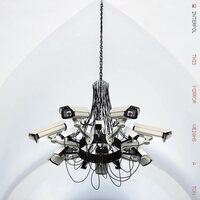
Time does not always move in a straight line. Sometimes it suspends itself, loops back, returns like an echo. “Time Deception”, the new album by Meeting By Chance - the solo project of Marcin Cichy from the group Skalpel - begins precisely in this gap between moments.
Meeting By Chance reveals another side of Cichy’s musical imagination. While Skalpel became known for transforming jazz samples into cinematic downtempo soundscapes, this project moves closer to ambient, IDM and classical electronic music. Beyond his work with Skalpel, Cichy is also a respected producer whose music has reached audiences far beyond the electronic scene. His collaboration with Lil Peep on the EP Changes brought him international recognition.
On Time Deception, the artist’s diverse fascinations converge: ambient soundscapes, the synthesizer aesthetics of 1980s electronics, the intricate rhythms of 1990s IDM and the spacious depth of dub techno. Yet the album is not a collage of influences - it unfolds as a coherent sonic narrative.
The title hints at its central theme: the way time bends, stretches and slips away from perception. Musical sequences loop like fragments of memory; rhythms appear and dissolve; melodies emerge from misty layers of synthesizers. At times the music evokes the cinematic worlds of Vangelis or Brian Eno, while elsewhere one can hear echoes of the subtle minimalism of Susumu Yokota and Ryuichi Sakamoto, alongside contemporary cinematic electronics in the spirit of Oneohtrix Point Never.
The single “Too Far” captures the character of the album particularly well. A looping piano motif intertwines with vocal samples, ambient textures, a deep bass pulse and almost jazz-like drums. The result is spacious and luminous — electronic music that, despite its digital tools, sounds strikingly organic and intimate. This sense of “breathing” music is one of the most distinctive elements of the record. The drums feel lively and tactile, never mechanical. The album suggests that even machines can carry something resembling a spirit.
Cichy’s music unfolds like a sequence of images - like photographs placed side by side, where meaning emerges in the space between frames. It is no coincidence that the project’s name comes from the famous 1970 photographic series by Duane Michals, in which two men pass each other in a narrow street, only to turn around moments later, as if they had recognized one another too late.
The album itself moves through shifting emotional landscapes. Its opening is darker and more dub-inflected, with suspended rhythms and a sense of time bending. Gradually the sound brightens, opening space for melody and harmony, culminating in more luminous pieces such as “Eden” and “View”. Time Deception ultimately becomes more than a collection of tracks - it is a meditation on memory, technology and the strange elasticity of time, where machines seem to breathe with an almost human rhythm.
- 1. So
- 2. Acantharia
- 3. Intention or Purpose
- 4. Rhythm XIX
- 5. Time Deception
- 6. Prince Rupert's Drop
- 7. Too Far
- 8. Eden
- 9. View
- 10. Blur