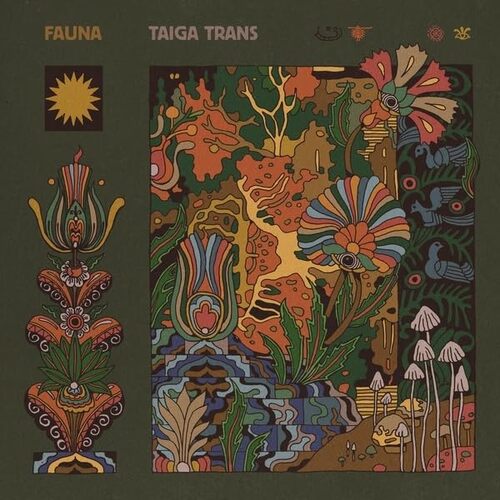

Taiga Trans, the debut album from Fauna, is a hypnotic collision of krautrock propulsion, psychedelic ritual, and subterranean rave energy.
The eight-piece Swedish outernational collective channels a multicultural, multidimensional sound that feels both deeply rooted and otherworldly. Think Goat’s feral mysticism, Can’s motorik drive, and a dancefloor at its most transcendental.
-----------
Electronic textures whoosh like solar winds. Quiet percussion sighs and chatters. A jaw harp sets up a twanging bounce. An ancient saz introduces a taut riff. Suddenly a high-strung electric guitar scorches and a deep, booming bass groove drops with a four-to-the-floor kick drum thud.
Welcome to the mysterious world of Fauna.
Since forming around three years ago, the Gothenburg-based group have forged a singular sound, proposing an imaginary world somehow outside of history. It’s a sound of cultures and philosophies entwining, creating a liminal space where traditional acoustic instrumentation meets electronic innovation. A place where new worlds are born.
The group’s origins go back to informal, intimate jam sessions held by guitarist Tommie Ek and bassist Ibrahim Shabo – two experienced musicians who had been playing together in the local rock scene for over a decade.
“We had played in a lot of constellations where we were pretty boxed in,” Shabo recalls. “So, we started experimenting. We recorded a bunch of hand drums and weird electric guitars and tried to find something.”
During the recording of these demos – and three subsequent singles – the core duo attracted a cohort of likeminded sonic adventurers, leading to the current live line-up as a nine-piece ensemble with Ek and Shabo joined by core members Caroline Kabat (drums), Cuneyd Kocalp (percussion), Jennie Magnusson (guitar), Ibrahim’s sister, Alexandra Shahbo (vocals) and French flautist Fauna Buvat.
In these days of manufactured sensations, Fauna offers an authentic alternative. “It’s more like an organic collective than the usual bands,” says Shabo. “Finding a nice, safe, awesome group to hang out with, that’s the main thing.”
In the last few years, they’ve built a reputation as an electrifying live act, performing long, semi-improvised, deeply psychedelic rituals. “We try to tell a story when we do our live sets,” says Shabo. “Try to stay in the vibe as much as possible.”
Now, their debut album, Taiga Trans, offers eight concise snapshots of that transporting experience, harnessing the band’s primordial live energy while making the most of 21st century studio technology.
Shabo explains: “We feel like a great album is something that you can put on and listen to for many years. To do that, it has to have certain elements of production. But we also wanted to keep the live part of it as well. The album is like the duality.”
Whether live or in the studio, a commitment to the consciousness-altering properties of the trance state sits at the centre of Fauna’s sound.
Listen to Taiga Trans and you’ll hear echoes of heroic 1960s/70s Swedish psychedelic bands like Träd, Gras & Stenar in the hypnotic, repetitive grooves of tracks like album opener “Bland Stenar.” You’ll hear the mind-melting squelch of vintage Acid House in tracks like “Bland Traden.” And you’ll hear the out-of-body euphoria of Techno in pieces like “Du Ska Fa Se.”
Running through all this is the added sensual twist of non-western instruments such as the darbuka (an ancient hand-drum played across North Africa and the Middle East) as well as the saz (the long-necked lute used in Turkish and Middle Eastern folk), featured on the album's opening track.
“A lot of things from our childhoods have leaked into our creativity,” explains Shabo – who comes from Syrian ancestry. “For example, my parents used to listen to a lot of stuff from the Middle East when I was growing up. A lot of that stuff comes up pretty naturally.”
“In the band, we have backgrounds from France, Finland, Poland, Syria, Sweden and Turkey. It’s a melting pot and the music reflects that.”
Another layer of this pan-global agenda can be found in Shabo’s lyrics – written in broken Arabic, Swedish and French and delivered with startling clarity by Alexandra, flautist Fauna and himself. But rather than trying to convey any pointed meaning, Shabo views his songwriting as, first and foremost, a way of thickening Fauna’s intoxicating sonic stew.
“The main thing for me is just to try and have a little fun with it,” he says. “The vibe is the most important thing about it. The sound and the rhythms. There are certain things that are hard to recreate with other instruments that the voice does really well.”
If the human voice can be seen as the original and oldest musical instrument, it’s followed closely by the drum and the flute, as played with sly and alluring delicacy by Fauna Buvat. And it’s these ancient sounds – slotted into the buzz of Fauna’s hypermodern rituals that make their music so overpoweringly seductive.
As Shabo says: “We want to be an experience that you can just dive into, let go and drift away.”
- 1. Bland stenar
- 2. En munfull sand
- 3. Dunans torka
- 4. Bland träden
- 5. Boreala ändlösheten
- 6. Du ska få se
- 7. Frusen mossa
- 8. Blodröda rubiner